Tabby: In our Primary 5 fractions lessons, we start with one question before any working: this fraction is a fraction of what?
A fraction of the remainder question is where that habit matters most. The words "of the remainder" tell us the fraction is no longer taken from the whole amount. It is taken from what was left.
Polly: So the numbers are fine. It is the "of what" that trips us up?
Tabby: Yes, Polly. Once a child can say what the fraction is "of", there are two tidy ways to solve it: the model method and the branching method. In this guide, we work through both on the same question so you can see how they match.
Three kinds of fraction in a word problem
Children often mix these up, so we name them first.
| Kind | What it looks like | What it means |
|---|---|---|
| Fraction of a unit | 3/4 m of ribbon | 3/4 of 1 metre. There is a unit behind the fraction. |
| Fraction of a set | 3/4 of his $40 | 3/4 of the whole amount, which is $30. |
| Fraction of the remainder | 3/4 of the remainder | 3/4 of what was left after something was used. |
What to say at home: "Is there a unit behind this fraction? If not, is it of everything, or of what was left?"
Fraction of the remainder: the question we will solve
Question. Mei had some beads. She used 1/4 of them for a bracelet. She used 2/3 of the remainder for a necklace. She had 15 beads left. How many beads did Mei have at first?
Tabby: Before any working, we highlight the keywords "of the remainder". The 1/4 is a fraction of all the beads. The 2/3 is a fraction of what was left after the bracelet.
Method 1: the model method
We draw one bar for all the beads and let the bar show us what is left.
- Step 1: Draw a bar and split it into 4 equal units. Label 1 unit "bracelet".
- Step 2: The remainder is the other 3 units. Write "remainder" above them.
- Step 3: 2/3 of the remainder is 2 of those 3 units. Label them "necklace".
- Step 4: 1 unit is left, and it stands for 15 beads.
- Answer: 4 units = 4 × 15 = 60 beads.
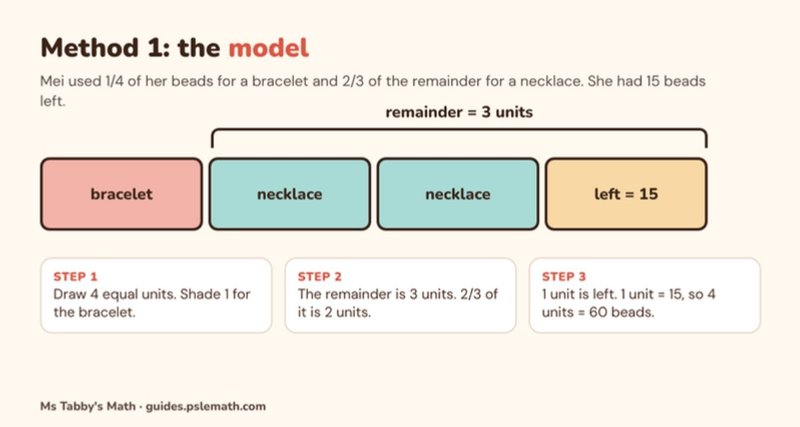
Sense check: 60 beads. Bracelet 15, remainder 45. Necklace 2/3 of 45 is 30. Left 45 − 30 = 15. It matches.
Method 2: the branching method
Polly: Why is it called branching?
Tabby: Because it looks like a tree. One whole splits into parts, and one of those parts splits again.
- Step 1: Write "All the beads" at the top. Branch it into 1/4 (bracelet) and 3/4 (remainder).
- Step 2: Branch the remainder into 2/3 (necklace) and 1/3 (left).
- Step 3: Multiply down the branch that ends in "left". 1/3 of 3/4 = 3/12 = 1/4.
- Step 4: 1/4 of all the beads is 15.
- Answer: All the beads = 4 × 15 = 60 beads.
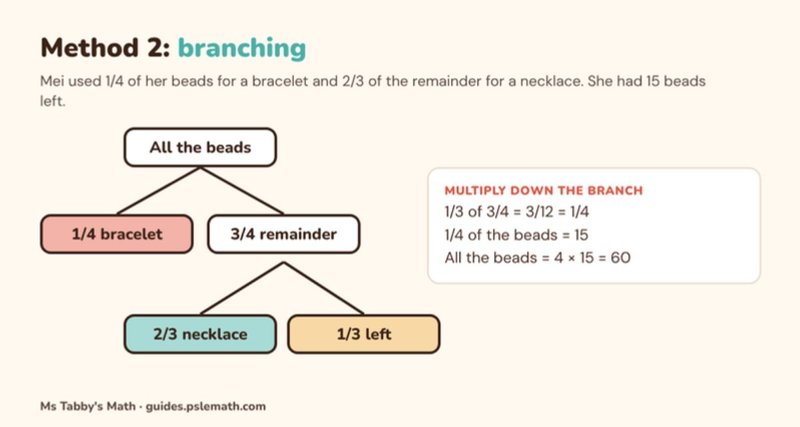
Sense check: Both methods give 60, and 1/4 of 60 is 15, the number of beads left.
Model method or branching method: which should my child use?
| Compare | Model method | Branching method |
|---|---|---|
| Best when | Your child needs to see the parts | Your child is steady with multiplying fractions |
| Strength | Shows the remainder clearly | Quick, with little drawing |
| Watch for | Units that need to be cut smaller | Forgetting the "left" branch |
In our lessons, we teach the model first and branching second. A child who can draw the model understands why the branching shortcut works.
There are also questions where branching does not fit well. If the first amount is a number and not a fraction, for example "he spent $120 and then 3/5 of the remainder", there is no first fraction to branch from. We draw the model.
When the units do not split evenly
Question. Ravi spent 2/5 of his money on a book. He spent 1/2 of the remainder on lunch. He had $12 left. How much money did Ravi have at first?
Tabby: The remainder is 3 units, and half of 3 units is awkward. So we cut every unit in half.
- Step 1: Draw 5 units. 2 units are for the book. The remainder is 3 units.
- Step 2: Cut every unit into 2 smaller units. Now there are 10 small units: 4 for the book and 6 in the remainder.
- Step 3: 1/2 of the remainder is 3 small units for lunch. 3 small units are left.
- Step 4: 3 small units = $12, so 1 small unit = $4.
- Answer: 10 small units = 10 × $4 = $40.
Sense check: $40. Book $16, remainder $24. Lunch $12, left $12. It matches. Branching agrees: 1/2 of 3/5 = 3/10, and 3/10 of $40 is $12.
A look-alike that is not a remainder question
Question. Mrs Tan baked some tarts. She gave 1/6 of them to a neighbour and 1/2 of them to her children. She had 16 tarts left. How many tarts did she bake?
Polly: Two fractions, one after the other. So it is "of the remainder" again?
Tabby: Read it once more. The question says "1/2 of them", not "1/2 of the remainder". Both fractions are of all the tarts.
- Step 1: Fraction given away = 1/6 + 1/2 = 1/6 + 3/6 = 4/6 = 2/3.
- Step 2: Fraction left = 1 − 2/3 = 1/3.
- Step 3: 1/3 of the tarts = 16.
- Answer: She baked 3 × 16 = 48 tarts.
Sense check: 48 tarts. Neighbour 8, children 24, and 48 − 8 − 24 = 16. It matches.
What to say at home: "Show me the words that tell you what this fraction is of."
Key points to remember
- "Of the remainder" means the fraction is taken from what was left, not from the whole amount.
- Find the remainder first, then take the fraction of it.
- The model method shows the parts on a bar. The branching method multiplies the fractions.
- If the question does not say "of the remainder" or "of the rest", both fractions are of the whole.
- Put the answer back into the story as a sense check.
Common questions from parents
What does "fraction of the remainder" mean?
It means a fraction of what is left after an earlier part has been used, spent or given away. The remainder becomes the new whole for that one sentence.
How do you solve fraction of the remainder questions?
Find what fraction is left after the first part, then take the second fraction of that. In the bead question, 3/4 is left after the bracelet, and 2/3 of 3/4 is 2/4. You can show this on a bar model or with branching.
Can my child use the branching method instead of the model?
In our experience, either method is fine as long as the working shows each step clearly. If your child's teacher prefers one method, follow that in school work.
My child keeps taking the fraction from the whole amount. What can we do?
This is very common, and it is not carelessness. Ask your child to write the remainder fraction above the word "remainder" before going on. In the bead question, that would be 3/4.
Which should we practise first?
The model. It shows what the remainder is. Branching comes more easily once your child can picture the parts.
One sentence at a time
A fraction of the remainder question is two small questions joined together. Find what is left, then take the fraction of that.
If comparing and renaming fractions still feels shaky, start with how to compare fractions. For choosing between methods more generally, our PSLE math heuristics checklist is a good companion. You can also download our fractions guide or see how we teach this topic in our Primary 5 lessons.
Polly: So I ask "of what?" every time.
Tabby: Every time, Polly.