Tabby: P6 math is the year the primary topics come together. Children meet a few new ideas, namely ratio, algebra, average and circles, and spend most of the year learning to combine them with the fractions, decimals and percentage they already know.
Polly: So it is the big, frightening year?
Tabby: It is the gathering year, Polly. Very little is brand new. The work is in choosing which familiar idea to use, and when.
This guide sets out what is taught in Primary 6, what is different from Primary 5, one worked question, and three small habits that help at home.
P6 math topics at a glance
Primary 6 adds a handful of topics to what children built in Primary 4 and 5. They sit in the same three strands used all through primary school: Number and Algebra, Measurement and Geometry, and Statistics.
| Area | What your child works on | What to watch for |
|---|---|---|
| Fractions | Dividing with fractions | Flipping the wrong fraction, or not knowing why the method works |
| Percentage | Harder percentage questions, including increase and decrease | Taking a percentage of the new amount when it should be the original |
| Ratio | Comparing two or three quantities in units | Treating the ratio numbers as the real amounts |
| Algebra | Using a letter for an unknown number | Reading 3n as "thirty-something" and not as 3 × n |
| Circles | Circumference and area of a circle | Mixing up radius and diameter |
| Volume | Finding a missing length of a cube or cuboid | Dividing by one side when the base area is needed |
| Geometry | Finding unknown angles in figures made of several shapes | Writing an angle without the reason for it |
| Average | Finding an average, and a total from an average | Averaging two averages without going back to the totals |
Polly: Eight rows. I can count them on my wings.
Tabby: And at least half of them are fractions wearing a different coat. Ratio, percentage and average all lean on the same idea of equal parts.
What is new in Primary 6 math?
Three things change between Primary 5 and Primary 6, and only the first is about content.
A few topics begin here. Ratio, algebra, average and circles are taught in Primary 6. If an older sibling learnt ratio or average in Primary 5, that was the earlier topic order. Speed, which older children also met, is no longer part of the primary syllabus.
Questions mix topics on purpose. A single question may open with a ratio, change one quantity by a percentage and ask for a fraction at the end. Each part is manageable. Seeing which part comes first is the skill being built.
Revision becomes part of the year. The PSLE is taken at the end of Primary 6 and draws on the earlier years as well, so children return to Primary 4 and 5 topics alongside the new ones. Our P5 math guide covers the topics that feed most directly into this year.
Polly: What if the Primary 5 ones are still wobbly?
Tabby: Then that is useful to know early. A wobble points to one connection that needs attention. It does not describe the whole child.
P6 math questions: one worked example
Here is one of our own questions in the upper primary style. It is a "before and after" ratio question, where one quantity changes and the other stays the same.
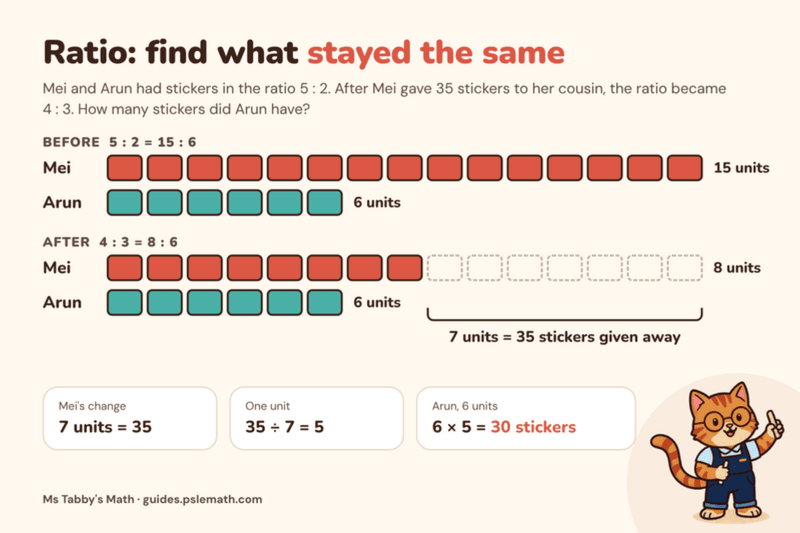
Question. Mei and Arun had stickers in the ratio 5 : 2. After Mei gave 35 stickers to her cousin, the ratio of Mei's stickers to Arun's stickers became 4 : 3. How many stickers did Arun have?
- Step 1: Find what did not change. Arun's stickers stayed the same.
- Step 2: Make Arun's units equal in both ratios. Before: 5 : 2 = 15 : 6. After: 4 : 3 = 8 : 6.
- Step 3: Compare Mei's units. 15 − 8 = 7 units, and 7 units = 35 stickers.
- Step 4: 1 unit = 35 ÷ 7 = 5.
- Step 5: Arun has 6 units: 6 × 5 = 30.
- Answer: 30 stickers.
Sense check: Mei had 15 × 5 = 75 stickers at first, and 75 : 30 = 5 : 2. After giving away 35 she has 40, and 40 : 30 = 4 : 3. It matches.
Tabby: Notice that the arithmetic is light. The thinking is all in Step 1. Once a child asks "what stayed the same?", the units line up and the rest follows.
If your child often cannot find the way into a question like this, our PSLE math heuristics checklist gives a short set of questions to ask before picking a method.
Three habits that help at home
You do not need to teach the topics yourself. These habits fit around whatever your child's school has set, and one question is enough to practise all three.
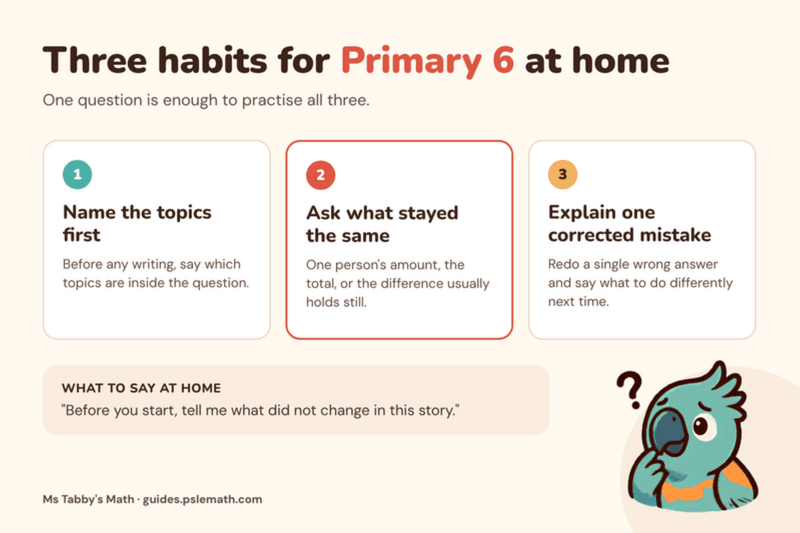
- Habit 1: Name the topics first. Before any writing, your child says which topics are inside the question. "This one has ratio, and something is being given away."
- Habit 2: Ask what stayed the same. In a changing-quantity question, one thing usually holds still: one person's amount, the total, or the difference. Finding it is often the first step.
- Habit 3: Explain one corrected mistake. After marking, choose a single wrong answer. Your child redoes it and tells you what they would do differently next time. One explained correction is worth more than a page of ticks.
What to say at home: "Before you start, tell me what did not change in this story."
Short, regular practice usually does more than one long sitting. Stop while your child can still explain their thinking. If you would like to place these habits inside a longer plan, our PSLE math roadmap shows how to set milestones without crowding the week.
Common questions from parents
Is P6 math hard?
It asks more of a child than Primary 5, mainly because questions combine topics and the year includes revision. The new topics themselves are within reach of a child whose fractions and percentage are steady. Where a child struggles, the cause is usually one earlier idea that needs revisiting, and that can be found and worked on.
What topics are in Primary 6 math?
Division of fractions, harder percentage questions, ratio, algebra, the circumference and area of circles, volume, unknown angles in geometric figures, and average. The table near the top gives the short version, with one thing to watch for in each.
Where can I find a P6 math paper to practise with?
Start with the worksheets and practice papers your child's school provides, because they follow the current topic order. Older papers found online may include speed, or place topics at a different level. One paper worked through slowly, with every mistake explained, teaches more than several done in a rush.
How can I help if I learnt a different method?
Ask your child to teach you theirs. Units, bar models and "before and after" tables may look unfamiliar, but they are the tools your child will be expected to use. Listening to the explanation is help in itself, and our resources library has printable guides that show the methods step by step.
P6 math, one connection at a time
P6 math brings the primary years together. Read the table, find the row that feels least secure, and practise the three habits on one question at a time.
To see how we teach this level in our lessons, visit our Primary 6 math page.
Polly: So it is not eight new mountains. It is one path with eight signposts.
Tabby: And you only need to read the next one, Polly.