Tabby: Parents often ask us how to score well in PSLE math, and they usually expect the answer to be "more practice papers".
Practice matters. But when we sit down with a child and a returned paper, we often find that a good share of the lost marks came from questions the child already knew how to do. The method was there. The marks slipped away somewhere between reading the question and writing the answer.
Polly: So the marks were earned, and then dropped on the way home?
Tabby: That is a fair way to put it, Polly. Today we look at how to carry them home safely.
This guide covers where marks tend to go, five habits that protect them, two worked examples written by our teachers, and a simple rhythm for PSLE preparation at home.
How to score well in PSLE math: start with where the marks go
Before adding more practice, it helps to read a paper your child has already done. Not for the total, but for the pattern. In our experience, lost marks fall into four kinds, and each kind needs a different response.
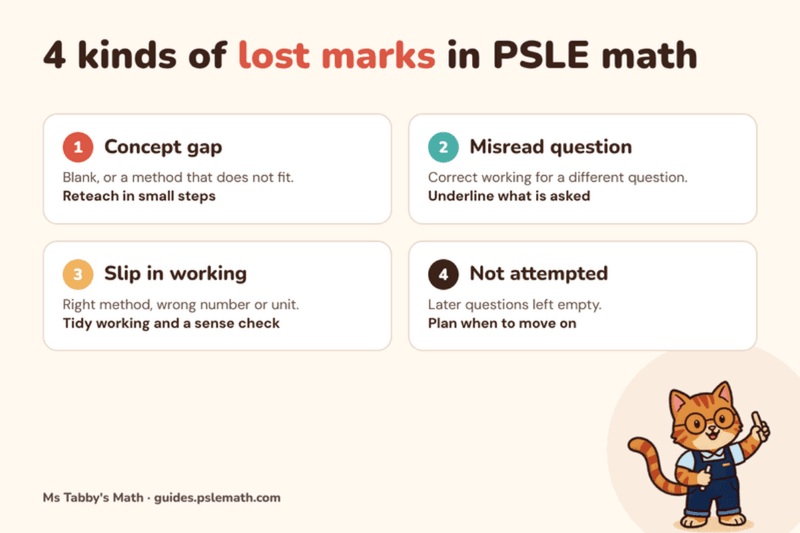
| Kind of lost mark | What it looks like on the paper | What helps |
|---|---|---|
| Concept gap | Blank, or a method that does not fit the question | Reteach the idea in small steps, then practise |
| Misread question | Correct working for a different question | Underline what is asked before starting |
| Slip in working | Right method, wrong number or wrong unit | Tidy working and a sense check |
| Not attempted | Later questions left empty | A plan for when to move on |
Polly: Only the first one is about not knowing the maths.
Tabby: Yes. The other three are habits, and habits can be taught.
What to say at home: "Let's sort these into two piles: the ones you did not know, and the ones you knew."
Five PSLE math tips that protect marks
The topics tested are set out in the MOE Primary Mathematics syllabus. These five habits sit on top of that content. They are simple, and they work best when practised a little at a time.
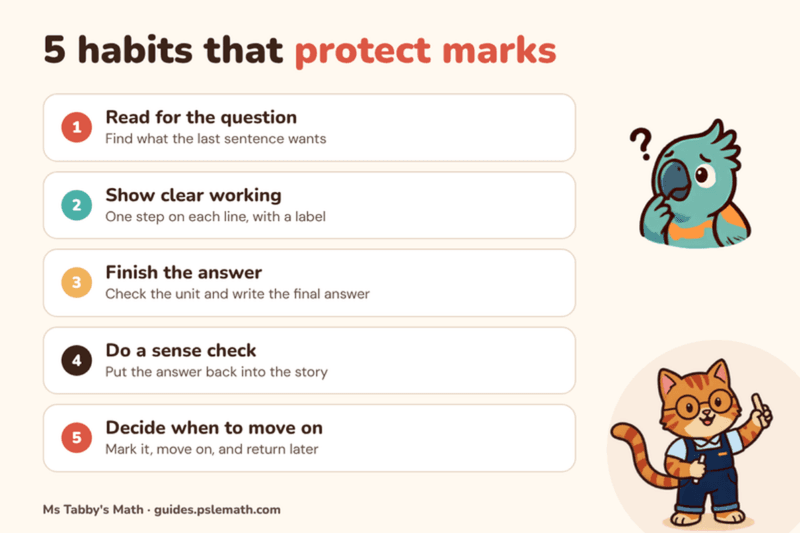
Read for the question, not for the numbers
Many children scan for numbers and start calculating. We ask them to find the last sentence first and say, in their own words, what it wants. "How many were left?" and "How many were sold?" use the same story and give different answers.
Write working that a stranger could follow
One step on each line, with a short label such as "Morning" or "Remaining". Clear working lets a child find their own slip, and it lets a marker see the thinking even when the final answer is not reached.
Finish the answer
Check the unit the question asks for, and write the final answer where it belongs. A correct 2400 in the working is not the same as a clear "16 cups" at the end.
Do a one-line sense check
Put the answer back into the story. Does it add up to the total? Is it a sensible size? This takes a few seconds and catches a surprising number of slips.
Decide when to move on
If a question has no first step after a fair try, mark it, move on, and return later. This keeps time for the questions your child can do. For the ones that still feel stuck on the second visit, our PSLE math heuristics checklist gives a short set of questions to ask.
Worked example 1: one question, three ways to lose a mark
Question. A baker made 240 buns. He sold 3/8 of them in the morning and 2/5 of the remaining buns in the afternoon. How many buns did he have left at the end of the day?
Tabby: The words that matter are "of the remaining" and "left".
- Step 1: Morning: 3/8 × 240 = 90 buns sold.
- Step 2: Remaining after the morning: 240 − 90 = 150 buns.
- Step 3: Afternoon: 2/5 × 150 = 60 buns sold.
- Step 4: Left at the end of the day: 150 − 60 = 90 buns.
- Answer: 90 buns.
Sense check: 90 sold in the morning + 60 sold in the afternoon + 90 left = 240 buns. It matches the total.
Here is how a child who understands fractions can still lose marks on this question:
- Misread: taking 2/5 of all 240 buns instead of 2/5 of the remaining 150.
- Stopped early: writing 60, which is the number sold in the afternoon, not the number left.
- Slip: working out 3/8 × 240 in a crowded corner and copying the result wrongly into the next line.
None of these is a concept gap. If "of the remaining" is the part that causes trouble, our guide to fraction of the remainder walks through it step by step.
Worked example 2: the unit that changes the answer
Question. A jug holds 2.4 litres of barley water. Mrs Tan pours all of it equally into cups. Each cup holds 150 ml. How many cups does she fill?
Polly: 2.4 ÷ 150 gives a very strange number.
Tabby: It does, Polly, because one amount is in litres and the other is in millilitres. We make the units match first.
- Step 1: Change litres to millilitres: 2.4 litres = 2400 ml.
- Step 2: Share into cups: 2400 ÷ 150 = 16.
- Answer: 16 cups.
Sense check: 16 × 150 ml = 2400 ml, which is 2.4 litres. It matches.
What to say at home: "Before we calculate, are both amounts in the same unit?"
How to prepare for PSLE math at home: a simple weekly rhythm
Parents who search for how to prepare for PSLE usually find long timetables. We prefer a short rhythm that a family can keep up.
- Short sittings, often. A focused sitting on a few questions, talked through properly, does more than a long sitting done tired.
- One habit at a time. Choose one of the five habits for the week. Praise the habit when you see it, whatever the answer.
- Sort mistakes by kind. Use the four kinds in the table above. A page of "knew it, misread it" needs a different week from a page of concept gaps.
- One timed practice, then a review. The review is where the learning happens, so leave time and energy for it.
- Mix easy and challenging questions. Confidence comes from both. When your child is ready for the trickier ones, see what makes the hardest PSLE math question hard.
If you would like to set this inside a longer plan with milestones and weekly reviews, our PSLE math roadmap shows how.
Common questions from parents
How can my child improve in PSLE math quickly?
The quickest gains usually come from marks that are already within reach: questions misread, units missed, answers not finished. Concept gaps take longer and deserve patience. We would start with the habits, and work on one gap at a time alongside them.
How do I help my child study for PSLE math if I learnt it differently?
You do not need to teach the method. Ask your child to explain each line of working to you. If they can explain it, they understand it. If they get stuck at a line, that line is what to bring to their teacher.
Should my child do more practice papers?
Only if the last one has been reviewed. A paper that is marked and put away teaches very little. One paper done, sorted by kind of mistake and corrected, is worth more than several done in a hurry.
Is it too late to start PSLE preparation in Primary 6?
It is not too late to build good habits, and habits are where many marks are kept. Be realistic about how many concept gaps can be closed at once, and choose the ones that appear most often in your child's own work.
Keep what has been earned
Learning how to score well in PSLE math is less about doing more and more about keeping what your child has already learnt: read the question, show the working, finish the answer, check it, and know when to move on.
You will find printable guides and checklists in our resources library.
Polly: So we are not learning more maths today. We are just not dropping it.
Tabby: Exactly, Polly. Steady hands first.